
A definitive guide for Whitehorse homeowners on furnaces, boilers, and keeping the heat on when it matters most.
If you live down south, a broken heater in January is an inconvenience. You put on a sweater and call a technician on Monday.
In Whitehorse, when it hits -40°C, a broken heater is a medical emergency for your family and a financial disaster for your property. A house without heat in deep winter can start freezing pipes within hours, leading to catastrophic water damage the moment they thaw.
At Next Level Plumbing & Gas Fitting, we don’t just fix heaters; we maintain life-support systems for your home. We know the unique anxiety that comes with hearing your furnace cycle off and waiting breathlessly for it to kick back on during a cold snap.
This guide is designed to be your definitive resource for heating in the North. We are breaking down the systems that work up here, how to stop burning money on inefficient fuel usage, and the critical maintenance steps that prevent 2:00 AM emergency calls.
1. Know Your Beast: The Two Kings of Northern Heating
While you might see electric baseboards in apartments or wood stoves as backups, the heavy lifting in the Yukon is almost always done by one of two systems. Knowing which one you have is step one in maintaining it.
The Forced Air Furnace
The most common system in North America. It burns gas or oil to heat a heat exchanger, and a blower fan pushes air across that exchanger and through ducts into your rooms.
- The Yukon Advantage: They heat up a space incredibly fast. If you turn up the thermostat, you feel it in minutes. They can also be integrated with central air conditioning or humidifiers (crucial for our dry winters).
- The Northern Challenge: They move air around, which can feel drafty. If your ductwork runs through an unheated crawlspace and isn’t perfectly insulated, you are losing massive amounts of heat before it ever reaches your living room.
The Hydronic Boiler
Common in newer builds or retrofits, boilers heat water (or a glycol mix) and pump it through radiators, baseboards, or in-floor radiant tubing.

The Yukon Advantage: This is often considered the “gold standard” for comfort in the North. Radiant heat doesn’t blow air around;
it radiates warmth from the floor up. It’s quiet, consistent, and doesn’t kick up dust.
The Northern Challenge: They are complex. They involve pumps, expansion tanks, zone valves, and crucial fluid chemistry.
They are slower to change temperature—you don’t just “crank it up” for quick heat.
2. The Efficiency Frontier: Stop Burning Money
Fuel costs in Whitehorse are no joke. Every winter, we see homeowners shocked by their heating bills, unaware that they are essentially throwing 30-40% of their fuel right up the chimney.
Efficiency is measured by AFUE (Annual Fuel Utilization Efficiency).
The “Old Guard” (60% – 70% AFUE) If your furnace or boiler has a metal exhaust pipe going up a chimney, it’s likely an older, mid-efficiency unit. For every dollar you spend on gas, 30 to 40 cents is used just to push hot exhaust out of your house. These units are reliable workhorses, but they are expensive to run.
The “New Standard” (90% – 98% AFUE) Modern, high-efficiency condensing units are game-changers in our climate. They squeeze almost every calorie of heat out of the fuel. They are so efficient that the exhaust gas is cool enough to be vented out the side of your house through PVC plastic pipe.
The ROI Reality Check: In a mild climate, upgrading from 70% to 95% efficiency might take 15 years to pay back. In the Yukon, with our heating loads and fuel costs, that upgrade often pays for itself in just a few winters.
3. The “Mid-Winter Failure” Survival Guide
It’s 11:00 PM on a Saturday into Sunday. It’s -38°C outside. You wake up shivering and realize the house is silent. The heat is off.
Panic is natural, but it won’t fix the heat. Before you call for emergency service (yes, we are available, but let’s try to save you the call-out fee first), check these three things:
1. The “Red Switch” Check Almost every furnace or boiler room has a red emergency switch on the wall, usually near the entrance or high up. It looks like a light switch. It happens constantly: someone bumps it while bringing in groceries or holiday decorations and cuts power to the unit. Flip it and see if the system reboots.
2. The Air Filter (Furnaces Only) If your furnace is short-cycling (running for 3 minutes, shutting off, then starting again), it’s likely overheating because it can’t breathe. A severely clogged filter will choke the system until a safety limit switch shuts it down to prevent a fire. Pull the filter. If it looks like a grey wool blanket, replace it (or leave it out temporarily for an hour to see if the heat stays on).
3. The Thermostat Batteries It sounds stupid. It happens every week. If your digital thermostat screen is blank or flashing a battery icon, your heater doesn’t know it needs to turn on. Swap the AAs.
If those three don’t work, call us immediately. Do not wait until morning.
4. Maintenance Mistakes That Kill Heaters Up North
We make a good living fixing broken heaters, but we’d rather make a living maintaining healthy ones. Most catastrophic failures we see in January could have been prevented in September.
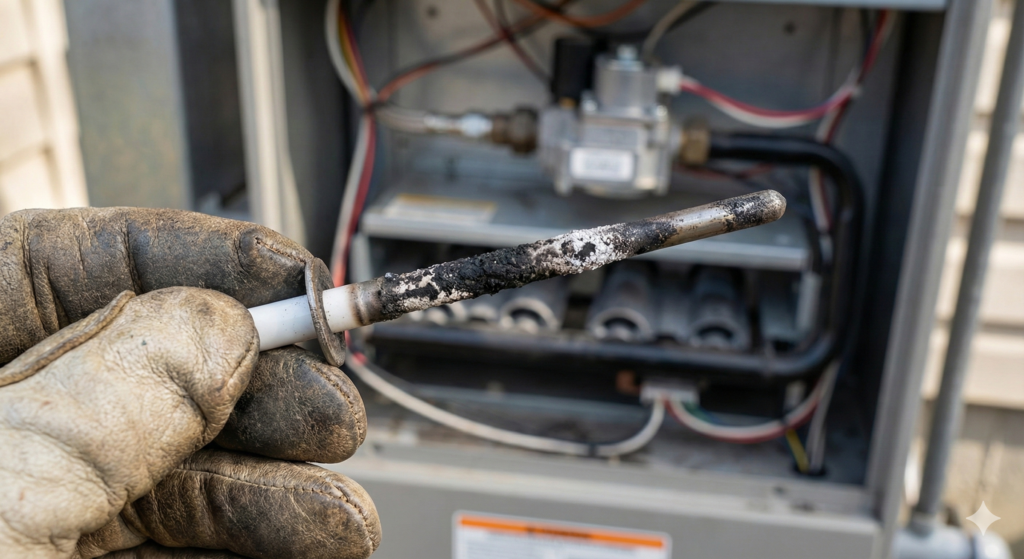
The “Flame Sensor” Issue (Furnaces) This is a small metal rod that sits in the fire. Its only job is to tell the computer board, “Yes, there is fire present.” Over time, it gets coated in carbon. If it gets too dirty, it can’t sense the flame, and the furnace will shut down the gas valve for safety. Annual cleaning is essential.
The Glycol Neglect (Boilers) If you have in-floor heating, you aren’t just pumping water; you are pumping a glycol (antifreeze) mix. This fluid prevents your floors from freezing if the power goes out.
- The Danger: Over 5-7 years, glycol breaks down and becomes acidic. It starts eating your pumps, seals, and expensive boiler components from the inside out. We test the pH and freeze protection level of your glycol annually. If it’s bad, it needs a full flush and refill.
Ignoring “The Noise” Your heater talks to you. A new rattle, a high-pitched squeal from a pump, or a booming sound when it ignites are all cries for help. Ignoring a $200 bearing replacement today leads to a $2,000 inducer motor replacement next month.
Conclusion: Don’t Gamble With the Cold
In the Yukon, your heating system is the engine that keeps your home running. You wouldn’t drive your truck for ten years without an oil change, especially not in winter. Don’t do it to your furnace or boiler.
Whether you need an emergency repair at 2:00 AM, want to discuss upgrading to a high-efficiency Viessmann boiler to slash your bills, or just need your annual safety inspection, Next Level Plumbing & Gas Fitting has the local expertise to handle it.
We live here. We know what cold means. Let us keep you warm.